A hard stop, not a usage dashboard.
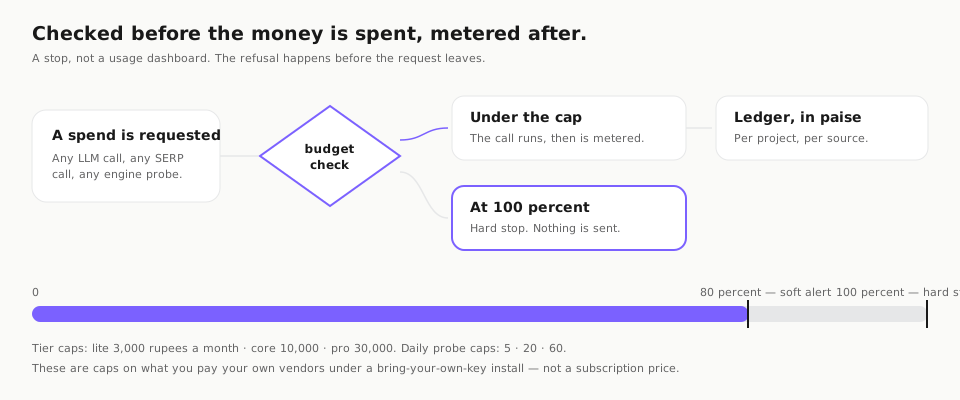
A dashboard is a receipt. This is a refusal.
Almost every AI tool bills after the fact and shows you a chart. That chart cannot stop anything: by the time a number is on it, the money is gone. Growzo puts the check in front of the call. Before an LLM request, a SERP query or an engine probe is issued, the remaining budget is consulted; if the spend would cross the cap, the request is never made. Metering happens afterwards, into a ledger denominated in paise, per project and per source.
80 percent — the soft alert
A warning, not a brake. Work continues, and the operator has room to raise the cap, narrow the tracked-query set or let the month finish. A stop nobody saw coming is a support ticket; a stop that announced itself twice is a decision.
100 percent — the hard stop
The next call does not go out. Inside the autopilot the budget is re-checked between every one of the eight workers, so a run that reaches the cap mid-pipeline halts at that boundary rather than completing an expensive stage first. See the eight-worker loop.
Three tiers, and the daily ceilings that matter more.
The monthly rupee cap is the outer wall. The per-day limits are the ones that shape behaviour, because they bound the recurring work — probing engines and re-checking positions — rather than the one-off work of publishing. Both are enforced at runtime rather than reported after the month closes.
| Tier | Monthly cap | Pages a day | Tracked queries | Probes a day |
|---|---|---|---|---|
| Lite | Rs 3,000 / month | 3 pages | 30 queries | 5 probes |
| Core | Rs 10,000 / month | 10 pages | 100 queries | 20 probes |
| Pro | Rs 30,000 / month | 30 pages | 500 queries | 60 probes |
Published unit costs, in rupees.
Every metered action has a published price, so the cap is not a black box you top up until the warnings stop. Four numbers cover almost all of it, and they are the same four the ledger bills against.
| Action | Unit cost | What one unit is |
|---|---|---|
| SERP call | Rs 0.30 | One Brave query for one tracked keyword |
| Engine probe | Rs 0.20 | One brand prompt sent to one AI engine |
| Publish | Rs 0.05 | One page published through the CMS |
| Embedding | Rs 0.01 | Per chunk embedded for retrieval |
The worst case, with every input shown.
A cap is only reassuring if you can check whether you will ever reach it. So here is the heaviest recurring load the product allows, worked through rather than asserted.
The inputs
Pro allows 60 engine probes a day, the highest daily probe ceiling in the product. An engine probe costs 0.20 rupees. A month is taken as 30 days.
The arithmetic
60 probes a day for 30 days is 1,800 probes a month. At 0.20 rupees each, that is 360 rupees a month — 12 rupees a day.
The conclusion
360 rupees sits far under the Core tier’s 10,000 cap, and nowhere near Pro’s 30,000. Sustained probing at the maximum permitted rate is not what exhausts a budget.
What actually does
LLM generation. Writing and editing pages is where the money goes, which is why the budget is re-checked between workers rather than only at the start of a run.
The point of showing the working is not the answer — it is that you can redo it. Every number in it is on this page: the daily probe ceiling from the tier table, the unit cost from the unit table. Nothing had to be taken on trust, which is the same standard the AI Crawler Blocking Index holds its own published research to.
A transparency page with zero customer data.
Growzo publishes its cost page from the same constants the ledger bills against. It is not a document someone remembers to update when a rate changes — it is arithmetic over the live constants, so the published figure and the billed figure cannot drift apart. And because it is computed from constants rather than from usage, it contains no customer data at all: there is nothing in it to leak.
One source, two readers
The runtime reads the constants to decide whether a call may happen. The public page reads the same constants to explain what a call costs. A single edit moves both, in the same direction, at the same moment.
Nothing about anyone
No project totals, no account names, no aggregate usage. A transparency page built from customer data has to be redacted, and redaction is where these pages quietly stop being published at all.
Honest empty states elsewhere
The same doctrine runs through the product: any surface without real data behind it renders an explicit sample-data notice, so a demo can never be mistaken for a measurement.
These caps are not a price for Growzo.
Worth saying twice, because rupee figures on a product page read like a price list and these are not one. Growzo is open source, self-hosted and bring-your-own-key. You hold the model, SERP and analytics accounts, the vendors invoice you directly, and the caps on this page are the ceiling the software refuses to cross while spending your money on your behalf. No subscription price is stated here, and none is emitted in this page’s structured data either.
Bring your own keys
Growzo’s only vendor SDK is Anthropic’s. Everything else it talks to is reached with credentials you supply and can revoke, which is also what makes a hard cap meaningful — the software is spending money it does not own.
Pre-1.0, and said so
Growzo is pre-1.0 software. The capability boundaries are published on the overview page rather than discovered after purchase, and the cost mechanism described here is one of the parts that is finished.
Cost questions, answered plainly.
Is 10,000 rupees the price of Growzo?
What actually happens at 100 percent of the cap?
What exactly is metered?
Where do the published unit costs come from?
What are the daily limits on each tier?
Why cap in paise rather than in credits?
Set the ceiling before you start.
Growzo runs on its own application and its own sign-in — an Autocloz account is not required. Pick a cap, and the software will refuse to cross it rather than explain it afterwards.