One inbox for the networks that answer.
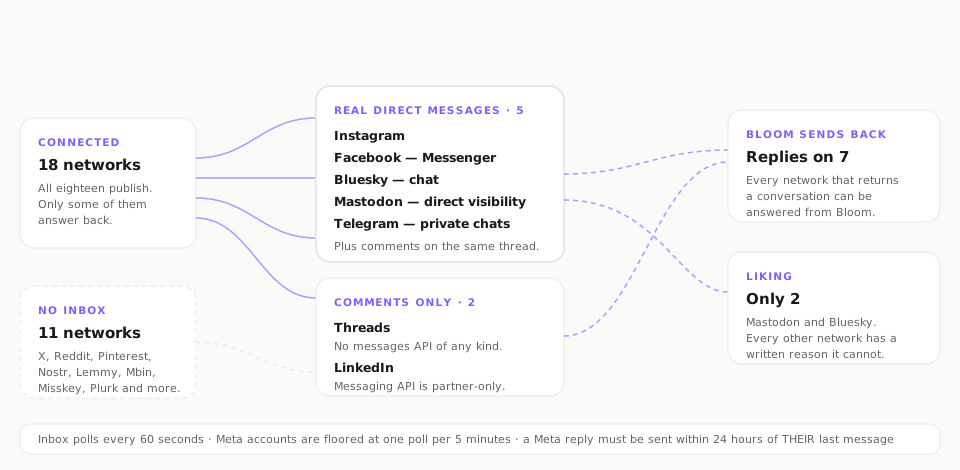
Seven networks answer. Here is what each one carries.
A unified inbox is only as useful as its coverage, and coverage is the number most tools decline to print. Bloom prints it. Publishing is universal here — every one of the eighteen networks on the coverage page can post, in the shapes the publishing pagesets out — but reading conversations back depends on whether the platform exposes a messages API at all, and eleven of them do not expose one Bloom can use. Those eleven are named below rather than quietly rendered as an empty folder, because an empty folder reads as “nobody wrote to you” when the truth is “nobody could tell you if they had.”
| Network | Conversations | What arrives | Like from Bloom |
|---|---|---|---|
| Yes | DMs + comments | No | |
| Facebook Pages | Yes | Messenger + comments | No |
| Threads | Yes | Comments only | No |
| Yes | Comments only | No | |
| Mastodon | Yes | Direct posts + replies | Yes |
| Bluesky | Yes | Chat + replies | Yes |
| Telegram | Yes | Private chats | No |
| The other 11 networks | No | No | No |
Replies on seven. Likes on two. Reasons for the rest.
Reading is half an inbox. The half that matters commercially is whether the answer leaves — and whether the tool tells you when it cannot. Bloom sends replies and comments on all seven networks it reads, through the same connected account the conversation arrived on. Liking is where the platforms diverge sharply, so instead of a hopeful button that fails silently, each network carries a written reason.
Replying, on all seven
A reply written in Bloom is sent as an immediate action, not queued behind the publishing queue, and it goes out through the connected account that received the message — so the person reading it sees your brand, not a relay handle. Comment replies work the same way on the four networks that expose native commenting on your own posts: Instagram, Facebook, Threads and LinkedIn.
Liking, on exactly two
Mastodon and Bluesky. Facebook removed the publish_actions permission in April 2018, the Instagram Graph API exposes no like endpoint, the Threads API has none at all, and LinkedIn’s reactions API is ambiguous enough that Bloom declines rather than fire a request that may do nothing while reporting success. A false success is the worst failure mode available to a social tool.
The 24-hour window, and the polling that respects it.
Meta’s messaging rules are the reason most social inboxes quietly lose replies. A page may answer inside a 24-hour window that starts at the other person’s most recent message — not at your last reply, and not when the thread was opened. Miss it and the send is refused at the API, usually long after the operator believed the conversation was handled.
The two cadences are deliberately different. Sixty seconds is fast enough that a Mastodon or Telegram reply feels live, and the five-minute floor exists because Meta counts every call against a per-account budget that a tighter loop would burn through on a busy workspace. That floor is applied per connected account rather than per platform, which is the same scoping Bloom's publishing rate governor uses — so one high-volume brand cannot spend a quieter one's allowance.
None of this changes what a reply is worth — it changes whether the reply is still allowed to leave. That is the whole argument for surfacing the countdown in the thread rather than discovering the closed window at send time.
Turning the inbox on asks you for nothing new.
The inbox reuses the credential already stored for each connected account. There is no second authorisation screen, no separate messaging app to install and no extra permission prompt for a network you have already connected for publishing — nine networks connect through one-click OAuth and nine take a pasted credential, and either way the inbox reads through the same stored token.
Per-account, not per-workspace
Conversations are keyed to the connected account they arrived on, so a workspace running several brands never merges two audiences into one thread list. Revoking one account’s token stops that account’s stream and leaves every other one running.
Credentials encrypted at rest
Stored with AES-256-GCM under a scrypt-derived key. The inbox never holds a second copy of a credential — it reads the one the publisher already uses, which is also why there is nothing extra to rotate when you change a token.
Roles apply to the inbox too
Bloom’s five workspace roles — owner, admin, editor, client and viewer — govern eight actions each, so a client can be given visibility of a conversation without being able to answer it on your brand’s behalf.
What this inbox deliberately is not.
The fastest way to lose a customer in month two is to let them assume a capability in month one. These are the four assumptions buyers most often arrive with, answered before they sign up rather than after.
Not a cold-outreach tool
Unsolicited direct-message outreach is not available on any of these APIs, and Bloom does not offer it. The inbox answers people who already messaged, commented on or replied to your accounts. Outbound sequencing to strangers belongs in a CRM on channels designed for it — see what Autocloz does for outbound.
Not joined to your posts
An inbox item is keyed to the connected account that received it. Bloom does not claim a link back to the specific scheduled item that prompted a comment, because the table holds no such reference — and inventing one in the interface would attribute conversations to the wrong content.
Not eleven networks
X, Reddit, Pinterest, Nostr, Lemmy, Mbin, Misskey, Plurk, dev.to, Tumblr and YouTube do not return conversations into Bloom. X read access is paid and Reddit needs its own OAuth application; for the rest, Bloom registers no inbox source at all.
Not a support desk
There are no tickets, no SLAs and no macros here. It is a single thread list across seven networks with replying, liking where the API allows it, and the platform limits made visible. Anything beyond that, tell us about it at contact before you assume it exists.
Inbox questions, answered plainly.
Which networks does Bloom's unified inbox read?
Can Bloom reply to messages and comments?
Why can Bloom only like posts on two networks?
What is the 24-hour reply window on Instagram and Facebook?
Can I use Bloom's inbox for cold DM outreach?
Does connecting the inbox require new permissions?
Answer them where they actually wrote.
Bloom runs on its own application and its own sign-in — an Autocloz account is not required. Connect one account or all eighteen networks, and the inbox fills in against the seven that answer.