Four AI engines. One real citation signal.
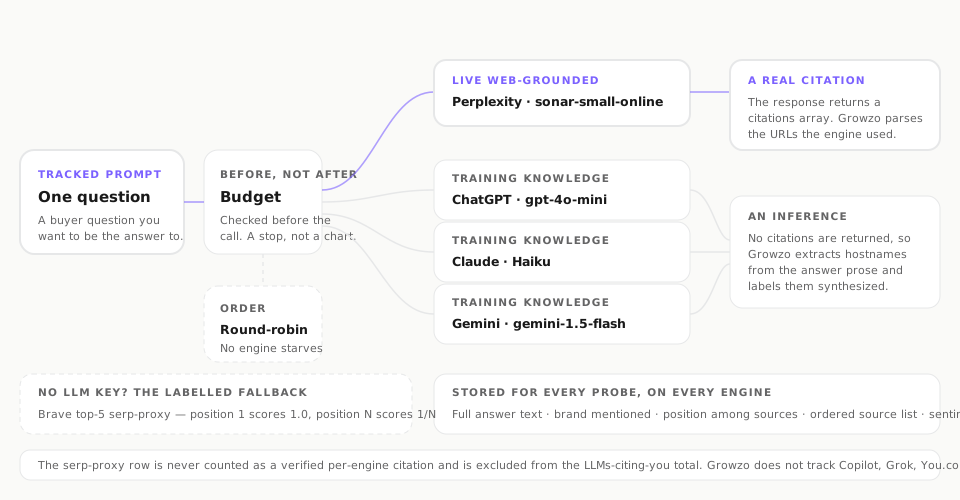
Four engines, and the line between citation and inference.
Every AI-visibility tool shows you a list of sources next to an answer. Almost none of them tell you where that list came from. It matters enormously: an engine with live web search hands back the URLs it actually consulted, while an engine answering from training weights hands back prose that merely mentions some domains. Growzo keeps the two apart in the data model, not just in a footnote, so a synthesized source can never quietly inflate the number of engines citing you. Each half has its own page: how a parsed Perplexity citation works, and what a ChatGPT brand probe really measures.
| Engine | Model | Grounding | Where the sources come from | Verified citation |
|---|---|---|---|---|
| Perplexity | sonar-small-online | Live web search | Parsed from the response's citations array | Yes |
| ChatGPT | gpt-4o-mini | Training knowledge | Synthesized from hostnames in the prose | Inference |
| Claude | Haiku | Training knowledge | Synthesized from hostnames in the prose | Inference |
| Gemini | gemini-1.5-flash | Training knowledge | Synthesized from hostnames in the prose | Inference |
| Brave serp-proxy | No model — fallback | Brave top-5 results | Search positions, labelled as a proxy | No |
Every probe stores six things, on every engine.
A mention is not a boolean. Growzo keeps the full answer text alongside whether your brand was mentioned at all, where you sat in the ordered source list, that list itself, a sentiment score for how you were described, and the word associations the engine reached for. That last one is the quietly useful field: knowing you are cited is one thing, knowing you are cited as “cheap” rather than “compliant” is what changes the next page you write.
Budget-gated before it runs
Every probe, every SERP call and every model call is checked against a hard money cap before it happens, and metered after. It is a stop, not a dashboard: at 80% of the cap Growzo alerts, and at 100% it refuses the call rather than continuing and billing you for the discovery. Daily probe caps are set per tier, and the published unit economics are computed from the same constants the ledger bills against.
Round-robin, not sequential
Engines are dispatched in rotation rather than one queue at a time, so a slow or rate-limited provider delays its own results instead of holding up the run. A day where one engine is degraded still produces three engines of usable data.
An AI Brand Score you can recompute by hand.
Growzo reduces the four engines to one 0–100 figure over a rolling 14-day window: the mean of your mention frequency multiplied by the mean of your position-inverse, times 100. Being mentioned often but last scores badly; being cited first but rarely scores badly too. Both halves have to be true, which is exactly how an AI answer behaves — the third source in a five-source answer is read far less than the first. The full derivation — both factors, the window, the delta and everything the score cannot see — is published on its own page.
The delta uses the same function
The previous-period comparison is not a second calculation. It calls the identical scoring function with the window shifted back, so the two numbers can never come from different formulas — the failure that makes most “up 12%” badges meaningless. If the score moved, the inputs moved.
Share of voice, per host
Over a 30-day window Growzo aggregates which hosts appear as sources for your tracked prompts and what share each one holds. It is the map of who currently owns the answer you want, and it is usually a shorter list than the search results for the same question.
A citation ledger, and five kinds of recommendation.
Every mention lands in a per-mention ledger — which engine, which prompt, which position, which sources sat above you, and the answer text as it was returned. That ledger is what makes a recommendation arguable rather than mysterious: you can open the row that produced it. From it Growzo emits five kinds of GEO recommendation.
create_comparison
Publish the comparison page an answer would need in order to name you next to the rival it currently names.
earn_citation
Go after a citation from a host that keeps appearing as a source on your tracked prompts.
add_schema
Add the structured data that anchors the passage an engine would otherwise have to guess at.
improve_position
Move up the source list. Position is half the score, so being cited last is worth far less than being cited first.
expand_coverage
Cover a tracked prompt your published corpus does not yet answer at all.
None of the five place a link, buy a mention or contact anyone on your behalf. They describe work a person does, which is the same posture Growzo takes in link building and in indexing — it finds opportunities and refuses to fake the outcome. The Growzo overview covers the rest of the workflow those recommendations feed into.
No LLM key? You get a proxy, clearly labelled as one.
Growzo is bring-your-own-key, and plenty of people evaluate it before adding one. Rather than showing an empty page, it builds a serp-proxy row from Brave’s top five results for the tracked prompt: position one scores 1.0 and position N scores 1/N. That is a reasonable stand-in for visibility and a terrible stand-in for a citation, so it is treated as exactly the first and never the second.
Labelled everywhere it appears
The row carries its provenance through the UI, so no chart can present a Brave ranking as though a model had quoted you. A visibility proxy that forgets it is a proxy is how a dashboard ends up lying to the person paying for it.
Excluded from the citation count
Proxy rows are left out of “LLMs citing you” entirely. The count means engines that returned a parseable citation, which today means Perplexity — and if that number is zero, Growzo shows zero.
Rank tracking is Brave only
One search engine, not seven. Google, Bing, Yandex, Baidu, DuckDuckGo and Naver have no implementation in Growzo, and AI Overview presence is a hard-coded placeholder rather than a measurement. Whether an engine can reach your pages at all is a separate question, answered on the AI crawler page.
Open source, self-hosted, pre-1.0
You can read the prober and count the engines yourself. That is the point of stating four instead of eight: on a product a buyer can inspect, an overclaim has a shelf life of about one afternoon. Questions welcome at contact, or see the rest of the product family.
AI citation questions, answered plainly.
How many AI engines does Growzo actually probe?
Does Growzo track Copilot, Grok, You.com or Phind?
Does Growzo detect Google AI Overviews?
How is the AI Brand Score calculated?
What happens if I have no LLM API key?
Is Growzo open source, and can I self-host it?
Track what an AI answer can actually prove.
Growzo runs on its own application and its own sign-in, on your own API keys. Add one key and the probes start; add none and you get the labelled proxy instead of an invented number.