AI visibility, reduced to one number you can recompute.
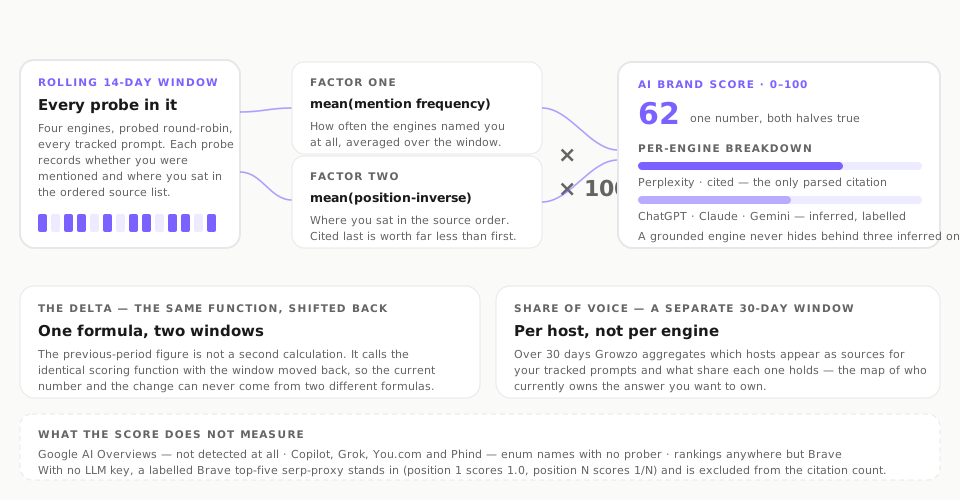
One score, two factors, and both have to be true.
Most AI visibility dashboards show a figure with no stated derivation, which means the only thing you can do with it is watch it move. Growzo publishes the arithmetic instead. Your AI Brand Score is the mean of how often the engines mentioned you across the window, multiplied by the mean of your position-inverse across the same window, multiplied by 100. It lands between 0 and 100 and it carries a per-engine breakdown, because an average over four engines with very different evidentiary weight would be a worse number than the four it came from.
Frequency without position is noise
Being named in every answer sounds like success until you notice you are named last every time. The third source in a five-source answer is read far less often than the first, and a metric that ignores order flatters exactly the position that earns you the least. That is why the second factor exists and why it multiplies rather than adds — a near-zero on either side pulls the whole score down, which is the honest behaviour.
Position without frequency is luck
The mirror failure. One first-place mention in a fortnight is a nice screenshot and a bad signal, because a single answer is a measurement of one moment rather than of a pattern. Averaging across the window is what turns an anecdote into something worth acting on, and a fortnight is short enough to still be current.
Every probe records six things, on every engine.
The score is a summary, and a summary is only trustworthy when you can open the rows underneath it. Growzo keeps the full answer text alongside whether your brand was mentioned, where you sat in the ordered source list, that list itself, a sentiment score for how you were described, and the word associations the engine reached for. Two of those six never reach the score at all and are kept anyway, because they change what you write next: knowing you are named is one thing, knowing you are named as “cheap” rather than “compliant” is another.
| Signal | The question it answers | Where it comes from | Hard evidence |
|---|---|---|---|
| Mention flag | Did the engine name you at all? | The answer text, every probe | Yes |
| Position | Where did you fall in the source order? | The ordered source list | Yes |
| Sources | Who else was named alongside you? | Parsed on Perplexity, inferred elsewhere | Mixed |
| Sentiment | How were you described, not merely that you were? | Scored from the answer text | Yes |
| Word associations | Which adjectives did the engine reach for? | Extracted from the answer text | Yes |
| Full answer | What exactly was said, verbatim? | Stored in full on every probe | Yes |
| AI Overview presence | Are you in a Google AI Overview? | Not measured — hard-coded placeholder | No |
Engines are visited round-robin rather than one queue at a time, so a rate-limited or degraded provider delays only its own results. A day where one engine is unhealthy still produces three engines of usable data, and the score says which engine is missing rather than quietly averaging over a hole. The engine matrix sets out all four side by side.
The change is the same function, on a shifted window.
A percentage badge is the easiest number on any dashboard to get wrong, because the comparison is usually computed somewhere else — a different window, a different rounding, sometimes a different definition of a mention. Growzo’s previous-period figure is not a second calculation at all. It calls the identical scoring function with the window moved back, so the two numbers cannot come from two formulas. If the score moved, the inputs moved. That is the whole guarantee, and it is worth more than a larger set of metrics computed loosely.
Share of voice runs on its own window
Separate from the score and deliberately longer: over 30 days Growzo aggregates which hosts appear as sources across your tracked prompts and what share each one holds. It is per HOST rather than per engine, because the question it answers is “who currently owns this answer?” — and the list is usually shorter and stranger than the search results for the same question.
A zero is not a measurement
The doctrine runs through the product: a source you never connected and a source with genuinely nothing to report are different facts, and collapsing both into a zero invents a result. If no engine cited you in the window, Growzo shows zero and says so. If an engine could not be probed, it says that instead.
What an AI Brand Score does not measure.
A visibility number is only safe to act on when you know its blind spots, and this product is open source and self-hosted — anyone can read the prober and check the list below in an afternoon. So it is published rather than discovered. None of these are roadmap teasers; they are the current boundary of what the software measures.
Google AI Overviews: not at all
AI Overview presence is hard-coded false in the rank worker as a deliberate placeholder. Growzo therefore reports nothing about AI Overviews rather than reporting a zero that a reader would take for absence. It is the single most-requested surface in this category and the most commonly overclaimed.
Four engine names with no prober
Copilot, Grok, You.com and Phind exist as enum values with nothing behind them, so they contribute nothing to the score. Any tool advertising eight-engine coverage is worth one question: which of the eight returns a citation, and which is being inferred from prose?
Rank tracking is Brave only
One search engine, not seven. There is no Google, Bing, Yandex, Baidu, DuckDuckGo or Naver rank tracker in the product. Search Console is a separate, real integration that reports the positions Google itself measured for you, with sixteen months of history.
No keyword volume or difficulty
Those numbers are not measured anywhere in the product, so they are not sold here. The genuine demand signal Growzo holds is your own Search Console history, including the queries you already rank fifth to twentieth for.
No backlink discovery
Growzo does the link arithmetic — anchor buckets, over-optimisation and unnatural-velocity flags, a Google-format disavow file — but it discovers no links itself and reports no domain rating, toxicity data or live-versus-lost tracking.
No guaranteed outcome, ever
AI engines are proprietary, personalised and query-dependent, and their answers differ between sessions. Nothing here claims a ranking, a citation, an indexing result or a lead. The score is a measurement with its evidence attached, which is a different promise and the only defensible one.
No LLM key? A labelled proxy, kept out of the count.
Growzo is bring-your-own-key and plenty of people evaluate it before adding one. Rather than render an empty page, it builds a serp-proxy row from Brave’s top five results for the tracked prompt: position one scores 1.0 and position N scores 1/N. That is a reasonable stand-in for visibility and a terrible stand-in for a citation, so it is treated as precisely the first and never the second — carried with its provenance through the UI and excluded from the count of LLMs citing you.
Every probe, SERP call and model call is checked against a hard money cap before it happens and metered in paise afterwards, with a soft alert at 80% of the cap and a refusal at 100%. A visibility tool that can spend without a ceiling is a different kind of risk from an inaccurate one. The cost caps are published in full.
A score is only useful if it names the next job.
Growzo turns the ledger into five kinds of GEO recommendation — publish the comparison an answer would need to name you, earn a citation from a host that keeps appearing as a source, add the structured data that anchors a passage, move up the source order, or cover a tracked prompt your corpus does not answer at all. None of them places a link, buys a mention or contacts anyone on your behalf. They describe work a person does, which is the difference between a research tool and an automated scheme.
Read the citation half first
Perplexity is the only engine whose answer can prove it consulted you, because its response carries a citations array Growzo parses rather than a paragraph Growzo has to interpret. How a parsed Perplexity citation works covers what that evidence is and what moving up the source order is worth.
Then read the inference half
ChatGPT, Claude and Gemini answer from training knowledge, so their source lists are synthesized rather than cited — and that distinction is invisible on a dashboard that flattens it. What a ChatGPT brand probe really measures explains what it does prove, which is more than nothing and less than a citation.
Check that they can reach you at all
Most citation failures are crawl-permission failures rather than writing failures, and one over-broad Disallow can remove a site from every AI surface at once while rank tracking shows nothing. The 13-crawler registry states what blocking each agent actually costs.
Then publish something worth citing
The autopilot runs eight workers in a fixed order with the budget re-checked between every pair, and QA is a real gate: thin content, a Jaccard uniqueness comparison against your own pages, a keyword-density band and an LLM utility score all have to pass before anything publishes. See the loop.
Growzo is open source, self-hosted and bring-your-own-key, and pre-1.0. That is also why the numbers here are stated precisely rather than generously: on software a buyer can read, an overclaim has a shelf life of about one afternoon. Questions are welcome at contact.
AI visibility questions, answered plainly.
What is an AI Brand Score?
What does AI visibility tracking actually measure?
How many AI engines does the score cover?
Does the AI Brand Score include Google AI Overviews?
Why does the previous-period delta use the same function?
What happens to the score if I have no LLM API key?
Can Growzo guarantee my AI visibility will improve?
Measure the answer, not the adjective.
Growzo runs on its own application and its own sign-in, on your own API keys. Add one key and the probes start; add none and you get a labelled proxy instead of an invented number.