Growzo will not tell you ChatGPT cited you. Here is why.
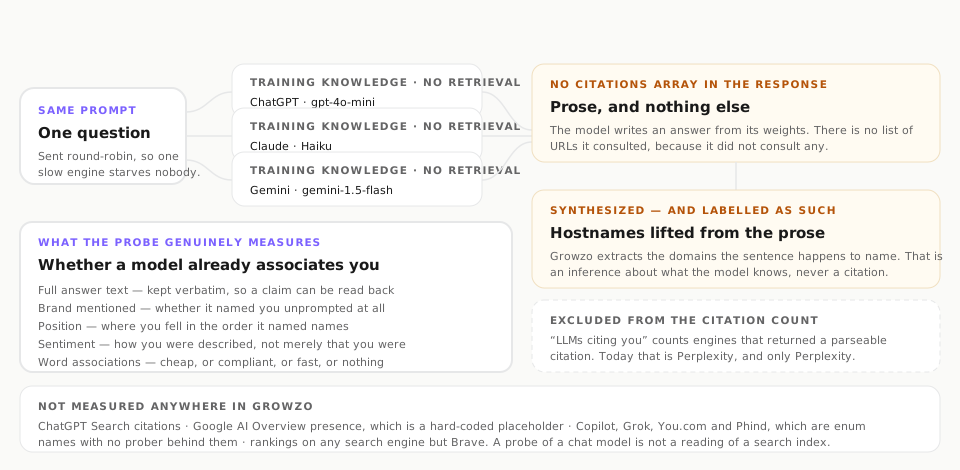
A chat model has nothing to cite.
When a model answers from training knowledge it is writing from what it learned long before your question existed. It opened no page, followed no link and consulted no index, so there is no list of sources for it to hand back. Anything presented as a source list for such an answer has to be reconstructed after the fact — usually by finding the domains the sentence happens to name. That reconstruction is a reasonable thing to do and a completely unreasonable thing to call a citation, and the gap between those two is invisible on a dashboard that renders both as a tidy row with a favicon.
| Engine | Model | What it reads | Where its sources come from | A citation? |
|---|---|---|---|---|
| ChatGPT | gpt-4o-mini | Training knowledge | Hostnames extracted from the answer prose | Inference |
| Claude | Haiku | Training knowledge | Hostnames extracted from the answer prose | Inference |
| Gemini | gemini-1.5-flash | Training knowledge | Hostnames extracted from the answer prose | Inference |
| Perplexity | sonar-small-online | Live web search | Parsed from the response's citations array | Yes |
Whether a model already knows who you are.
A training-knowledge probe answers a question no crawl log and no rank tracker can: when a model reaches into what it learned and is asked which tools solve this problem, does your name come out? That is brand knowledge rather than retrieval, and it moves on a completely different timescale — slowly, and mostly in response to how widely and how consistently you are described elsewhere. Growzo records six fields on every probe, and the two that never reach the score are often the two worth reading first.
Word associations are the quietly useful field
Knowing a model names you is one thing. Knowing it names you as “cheap” rather than “compliant”, or as “for freelancers” when you sell to enterprises, is what changes the next page you write. It is the closest thing in the product to reading your own positioning back from the outside, and it costs one probe.
Sentiment is not the same as presence
Being named in a sentence that goes on to describe you as the limited option is a worse outcome than not being named at all, and a boolean mention flag cannot see the difference. Growzo scores how you were described from the same stored answer text, so the two facts stay attached to each other.
Mentions and positions from these three engines do feed the AI Brand Score — the mean of your mention frequency multiplied by the mean of your position-inverse, times 100, over a rolling 14-day window — but the synthesized source list is never counted as a verified citation. The full derivation is published, including the per-engine breakdown that keeps one grounded engine from hiding behind three inferred ones.
ChatGPT Search is not the model Growzo probes.
This is the confusion the whole category runs on. ChatGPT Search cites from its own index, crawled by OAI-SearchBot. The probe Growzo runs talks to a chat model over an API and touches no index at all, which is why it cannot report a ChatGPT Search citation no matter how the result is presented. What Growzo can do about that surface is check whether you are permitted into it — and access is verifiable in a way prose quality never is, which makes it the cheapest real work on this page.
| OpenAI token | What it is for | What blocking it costs you |
|---|---|---|
GPTBot | Model training | Blocking it excludes you from OpenAI training data and leaves ChatGPT Search citations untouched. |
OAI-SearchBot | The ChatGPT Search index | Blocking it removes you from ChatGPT Search citations entirely. Almost never the intent. |
ChatGPT-User | A live fetch for a user | Blocking it means ChatGPT cannot open your page when someone's prompt causes a browse. |
A synthesized source looks exactly like a real one.
Put the two side by side on a screen and they are indistinguishable: a domain, a favicon, a position number. That is precisely why the distinction has to live in the data model rather than in a footnote a product manager can quietly delete. Growzo stores what kind of evidence each source row is, carries that provenance through the UI, and keeps synthesized rows out of the count of LLMs citing you — so no chart can present a hostname found in a sentence as though a model had quoted you.
Strict on one number, generous on the rest
This is the compromise worth understanding, because it is the opposite of the usual one. Growzo will happily use a training-knowledge probe to tell you a model named you third and called you affordable — that is real information and it is reported in full. What it refuses to do is let that probe increment a number whose name promises evidence. One metric is held to the strictest possible standard precisely so the other fifteen can be useful without anybody having to audit them, and so a reader who quotes “one LLM cites us” in a board deck is not quoting an inference.
Excluded from the citation count
“LLMs citing you” means engines that returned a parseable citation. Today that is Perplexity, and only Perplexity. If the number is one, Growzo shows one. If it is zero, it shows zero rather than borrowing three inferred rows to round it up.
The same rule for the no-key proxy
Without an LLM key Growzo builds a labelled serp-proxy row from Brave’s top five results — position one scores 1.0, position N scores 1/N — and excludes it from the citation count for exactly the same reason. A search ranking is not evidence that a model named you.
Four names with no prober at all
Copilot, Grok, You.com and Phind are enum values with nothing behind them. They are not probed, not scored and not counted. Any tool selling eight-engine coverage is worth one question: which of the eight returns a citation?
No AI Overview detection
Google AI Overview presence is hard-coded false in the rank worker as a deliberate placeholder, so Growzo reports nothing about it rather than a zero a reader would take for absence. Rank tracking is Brave only.
Round-robin, budget-gated
The engines are visited in rotation so a slow provider delays only its own results, and every probe is checked against a hard money cap before it happens and metered in paise after. The caps are published with their arithmetic shown.
Readable, because it is open
Growzo is open source, self-hosted, bring-your-own-key and pre-1.0. Every number on this page can be checked against the prober by anyone who runs it, which is the real reason the wording is careful. The overview page carries the full list of what the product does not do.
Nothing here claims or implies a guaranteed mention, citation, ranking or lead — AI systems are proprietary, personalised and query-dependent, and their answers differ between sessions. What Growzo offers is a measurement with its evidence attached and an honest label on the half that is inference. The four-engine matrix puts every row in one table, and contact is open for the awkward questions.
ChatGPT brand-mention questions, answered plainly.
Does ChatGPT cite my site, and can Growzo tell me?
Then what does a ChatGPT brand probe actually measure?
Why can a training-knowledge probe not return citations?
Is ChatGPT Search the same thing as ChatGPT?
Does blocking GPTBot stop ChatGPT from citing me?
Does the inferred source list count toward my AI Brand Score?
Know which half of your AI visibility is evidence.
Growzo runs on its own application and its own sign-in, on your own API keys. It reports the mention, the position, the sentiment and the words — and tells you plainly when the source list was inferred.