Perplexity is the one engine that can prove it cited you.
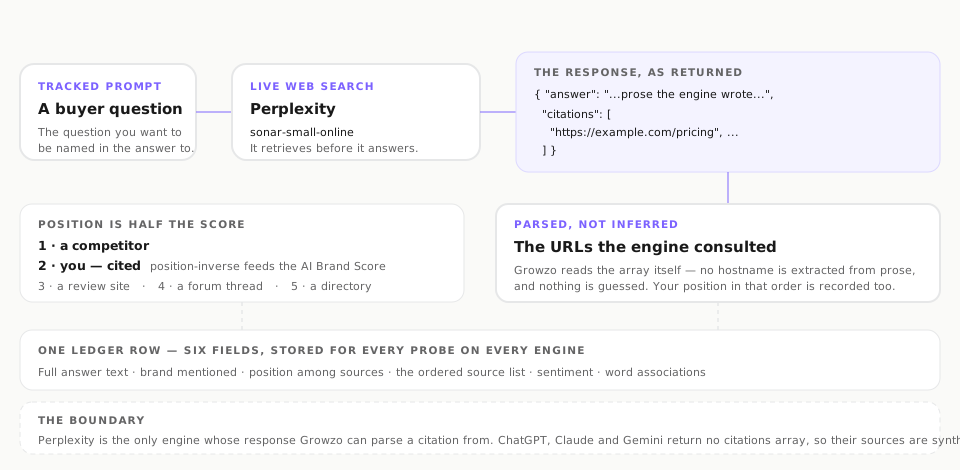
What a parsed citation actually is.
Perplexity retrieves from the live web before it writes anything, and the response it returns carries two parts: the prose a reader sees, and a list of the sources that prose was built from. Growzo reads the second part directly. There is no regular expression over the answer, no guessing which domain in a sentence was a source rather than an aside, and no reconciliation step where a hostname mentioned in passing gets promoted to a citation. The array names the URLs; Growzo records them.
Why the distinction is not pedantry
On a dashboard a synthesized source list and a parsed one render identically: a logo, a domain, a tidy row. One of them is a record of what an engine consulted and the other is an artefact of a hostname appearing in a sentence. Treating them as the same number inflates the count of engines citing you, and it inflates it in the direction every vendor is tempted to inflate it.
The whole answer is kept
Not a snippet, not a hash — the full text as it was returned. That is what lets a recommendation be argued with rather than obeyed: you can open the row that produced it, read the answer, and see which four hosts sat around you. A recommendation without its evidence is an instruction from a black box.
Cited last is not the same as cited.
The citations array is ordered, so your place in it is a fact rather than an estimate — and that place is half of Growzo’s AI Brand Score, which multiplies mean mention frequency by mean position-inverse over a rolling 14-day window. A tool that counts citations without weighting order will report that you are winning a question you are quietly losing, because the third source in a five-source answer is read far less than the first. Multiplying rather than adding is deliberate: a near-zero on either factor pulls the whole number down, which is the honest behaviour.
Share of voice, per host
Over a separate 30-day window Growzo aggregates which hosts appear as sources across your tracked prompts and what share each one holds. It is the map of who currently owns the answer you want, and on most commercial questions it is a shorter and stranger list than the search results for the same phrase — which is exactly why it is worth looking at on its own.
improve_position is its own recommendation
Growzo emits five kinds of GEO recommendation, and moving up an order you are already in is one of them — distinct from earning a first citation, because the work is different. It is usually the cheapest real gain available, since the engine has already decided you are relevant.
What a citation proves, and what it does not.
This is the part most AI-visibility marketing skips, and it is the part that decides whether a number is safe to put in a board deck. A parsed citation is strong evidence about one specific thing and no evidence at all about several adjacent things a reader might assume it covers. Both columns below are stated so nobody has to infer the second one from the absence of the first.
The engine consulted your URL
It is in the array the response returned — not a hostname found in a sentence.
Where you ranked among sources
The array is ordered, so position is a fact rather than an estimate.
Who was cited instead of you
Every other URL in the array, on every probe, for every tracked prompt.
How you were described
Sentiment and word associations are scored from the full answer text.
That a human read that answer
Answers are generated per query and per session. No tool can see the audience.
That the next answer will cite you
Retrieval is proprietary and varies by query. One probe is one moment.
That you rank in any search engine
Growzo's rank tracking is Brave only, and that is a separate measurement.
That ChatGPT or Gemini cited you
They return no citations array. Their sources are inferred and labelled.
The honest summary: Growzo can tell you that Perplexity consulted your page on a prompt you chose to track, and where you sat among the sources it used. It cannot tell you that a person read that answer, and it will not pretend to. How the AI Brand Score is computed sets out the arithmetic that turns those probes into one number.
What actually changes whether you get cited.
Nothing on this page is a lever anyone can pull on your behalf, and the largest single cause of a missing citation is not writing quality at all — it is access. An engine that cannot fetch your page cannot cite it, and that failure is invisible in rank tracking because your rankings do not move. So the order below is deliberate: access first, because it is verifiable, then the passage-level work, which is not.
| The lever | Why it matters for a cited answer | Where Growzo measures it |
|---|---|---|
| PerplexityBot access | It is the crawler behind the index Perplexity cites from. A Disallow removes you from the citation list entirely. | The 13-bot registry and robots.txt reader — see the crawler tier |
| Self-contained passages | An engine quotes one passage and has to be correct on its own. GEO scoring looks for roughly 40 to 120 word passages that stand alone. | The per-page GEO score, written on every save |
| Real numbers and named sources | Evidence density, original-claim language, how many real statistics the page carries and how many sources it names. | The same GEO score, broken into its components |
| A stable anchor to cite | A positional id like section-3 drifts to different text when the page grows a section, and the cited deep link silently moves. | AEO scoring, which flags positional anchors |
| A page that exists at all | expand_coverage exists for tracked prompts your published corpus does not answer. There is nothing to cite on a question you never wrote about. | The GEO recommendation engine |
Everything this page is careful not to claim.
Growzo is open source, self-hosted and bring-your-own-key, so a buyer can read the prober and check every sentence above in an afternoon. That is the reason the limits are published rather than left to be discovered: an overclaim on inspectable software has a very short shelf life, and the list below is more useful than the claim it replaces.
One probe is one moment
Perplexity answers a question fresh each time, and its retrieval is proprietary. A probe records what happened on that run, which is why the score averages a 14-day window rather than reporting the most recent answer as a status.
Four engines, not eight
Copilot, Grok, You.com and Phind appear in an internal enum with no prober behind them, so Growzo tracks nothing about them. This page will keep saying four until there is a fifth measurement to report.
No AI Overview detection
Google AI Overview presence is hard-coded false in the rank worker as a deliberate placeholder, so Growzo reports nothing about it rather than a zero that would read as absence. Rank tracking itself is Brave only.
No audience measurement
An AI answer is generated for one person in one session and is not published at a URL anyone can count. Growzo measures whether you were cited on prompts you chose to track, never how many people saw it.
Spending has a ceiling
Every probe is checked against a hard money cap before it happens and metered in paise after, with a soft alert at 80% and a refusal at 100%. The published unit economics are computed from the same constants the ledger bills against.
Pre-1.0, and said so
Growzo is pre-1.0 software. What is finished is described as finished and what is not is named — including on the overview page, which carries a whole section on what the product does not do.
The counterpart to this page is the one about the engines that cannot do any of it: what a ChatGPT, Claude or Gemini probe measures when there is no citations array to read. And the four-engine matrix puts all of them in one table. Anything unclear is worth an email to contact.
Perplexity citation questions, answered plainly.
How does Growzo track Perplexity citations?
What makes a Perplexity citation different from a ChatGPT mention?
Can Growzo guarantee I will get cited by Perplexity?
Why does position inside the citation list matter so much?
Does blocking PerplexityBot affect this?
What does Growzo store for each Perplexity probe?
Track the one citation that is actually a citation.
Growzo runs on its own application and its own sign-in, on your own API keys. Track the prompts you want to be the answer to, and read the array rather than the adjective.