300 characters, and Bloom counts them.
What Bloom does with a Bluesky account.
Bluesky is the network where a scheduler’s honesty shows up fastest, because its limit is low enough that a shared draft written for anywhere else will not fit. Bloom treats that as a compose-time fact rather than a publish-time surprise: the count runs against 300 as you write, a thread is offered when one idea genuinely needs more than one post, and the record identifier that comes back from a successful publish is kept rather than discarded. Engagement, conversations and likes all flow back afterwards, which puts Bluesky in the small group where Bloom closes the loop completely.
The record CID is kept, not thrown away
Bluesky runs on the AT protocol, where a published post is a record with a content identifier. Bloom stores that CID against the post it published, so the item stays addressable afterwards rather than becoming a row that merely claims something was sent. It is a small piece of bookkeeping that is the difference between a publishing log and an audit trail.
Threads, because 300 is not much
Bluesky is one of three Bloom networks with native thread support, alongside Mastodon and Telegram. At 300 characters per part, a thread is not a stylistic choice on this network so much as the only way to carry an argument — and twenty-five parts is the ceiling, with ten the default a thread starts from.
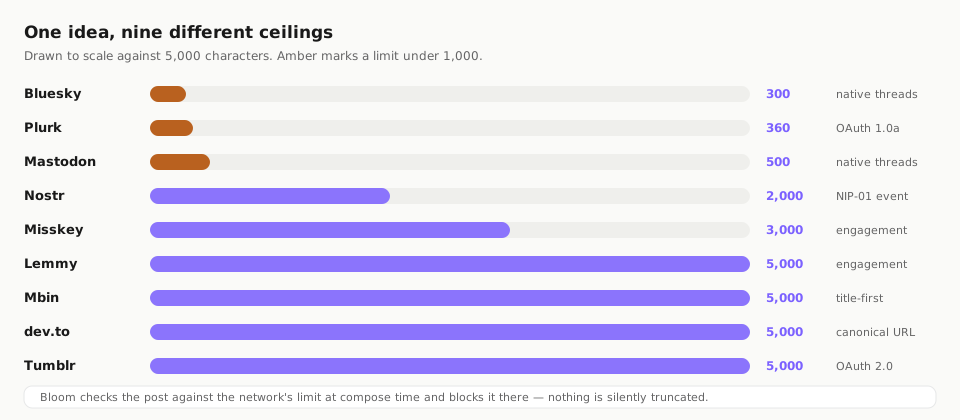
The shortest limit of the nine, enforced first.
Three hundred characters is less than Plurk’s 360, less than Mastodon’s 500, and one sixteenth of what Lemmy, Mbin, dev.to and Tumblr accept. It is only twenty more than X. Any workflow that composes once and fans out unedited will therefore break on Bluesky first, which is why Bloom tailors one idea per network instead of posting a single string everywhere and letting the shortest platform decide where the sentence ends.
The failure this prevents is specific and public. A 341-character draft sent to a naive scheduler either fails at the API and disappears from the calendar, or is trimmed to 300 and published with the verb missing. Bloom does neither: preflight blocks it before the post is stored, shows the overrun, and offers the thread that would carry it. Carousels are not a Bluesky shape — they exist on two of the eighteen networks — so that option is declared unavailable rather than silently dropped. Compare every ceiling on the coverage page, or read how a blocked post is reported in publishing and scheduling.
Bluesky connects with a pasted credential.
Bloom’s eighteen networks split evenly on this: nine link through a one-click OAuth redirect, nine take a credential you paste. Bluesky is in the pasted half, as are seven of the nine fediverse networks — Tumblr alone uses OAuth. The step happens once per account. After that, publishing, engagement sampling, inbox polling and likes all run against the stored credential with no further prompting.
Encrypted at rest
Whatever route a credential arrives by, Bloom stores it under AES-256-GCM with a scrypt-derived key. The connect method decides how a token gets in; it has no bearing on how the token is kept once it is there.
One governor per Bluesky account
Each connected account gets its own maxPerDay ceiling and minIntervalMinutes gap. Platforms rate-limit an account rather than a logo, so a per-platform budget shared across a client roster would throttle everyone because one account had a busy Tuesday. Scoping the governor to the account is what makes an agency workspace safe.
Roles decide who holds it
Five workspace roles — owner, admin, editor, client and viewer — are checked against eight distinct actions. Drafting a Bluesky post and connecting the Bluesky account are two of them, and they are not the same permission.
Engagement, chat DMs and likes all return.
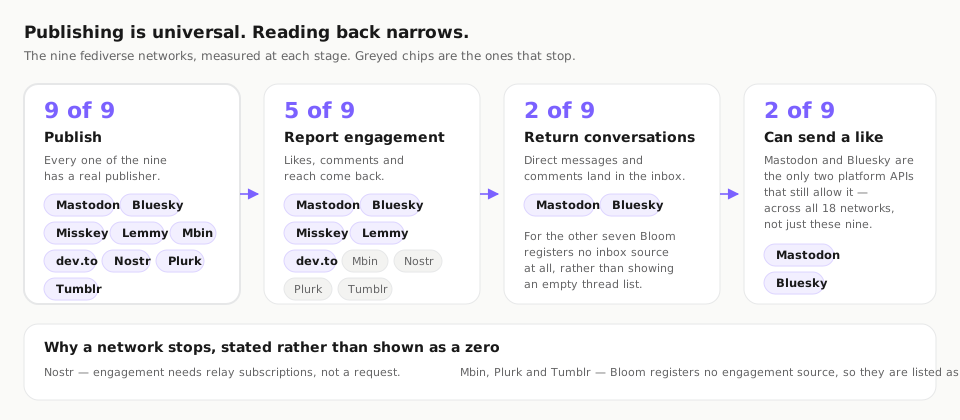
Bluesky is one of only two fediverse networks where Bloom does everything it can do anywhere: publish, read engagement, receive conversations and send a like. Its direct messages come through the Bluesky chat service and land in the same thread list as Instagram, Facebook, Threads, LinkedIn, Mastodon and Telegram — seven networks in total out of eighteen, which is the honest figure and the one worth checking a competitor against.
Engagement collected from Bluesky feeds the same learner as every other reporting network: twelve hooks, six formats and six time buckets, tracked as twenty-four factored arms rather than four hundred and thirty-two full combinations, which is what makes it informative in roughly a hundred posts instead of across several years. Conversations are keyed to the connected account that received them — Bloom does not claim a link back to the specific post that prompted a reply, because the inbox table carries no such column and inventing one would attribute conversations to the wrong content.
A queue built not to burst.
A 300-character network invites short, frequent posting, which is exactly the rhythm that gets an automated client throttled. Bloom’s constants exist to make frequency a decision you make rather than an accident the queue produces after an outage.
Ten catch-up posts per tick
When Bloom comes back from downtime it releases at most ten backlogged posts per five-minute tick, and skips anything more than 24 hours past its slot. A burst is the pattern platforms suspend accounts for; draining slowly is the whole point.
Bounded retries
Five attempts per target, with backoff doubling from 60 seconds under a six-hour ceiling — so real waits are one, two, four and eight minutes. After that the post stops and the failure becomes a state you can see rather than a gap in the calendar.
A year of horizon, a 30-day guard
Weekly slots project up to 365 days ahead in the brand’s own timezone, and a duplicate guard covering 30 days stops the same content reaching the same Bluesky account twice inside a month.
Bluesky next to the seventeen others.
Bluesky rarely stands alone in a plan. Bloom composes one idea and tailors it per network — 300 characters here, 500 on Mastodon, 2,000 on Nostr — through one weekly queue and one four-state approval chain. See how the whole loop closes on the Bloom overview, or read the eighteen-row table on the coverage page.
Bluesky questions, answered plainly.
What is the Bluesky character limit in Bloom?
Can Bloom post Bluesky threads?
Does Bloom read Bluesky engagement and DMs?
Does Bloom keep the AT-protocol record for a published post?
How is a Bluesky account connected?
Give Bluesky its own 300 characters.
Bloom runs on its own application and its own sign-in — an Autocloz account is not required. Connect a Bluesky account and the character gate, the thread builder, the engagement figures and the chat inbox fill in against your own posts.