Mbin publishes. It does not report.
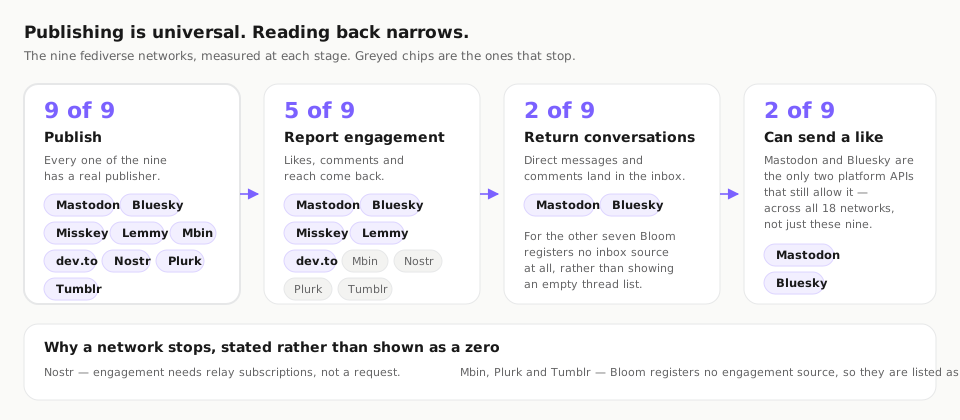
A publisher, stated as exactly that.
Mbin is the clearest case in this family of a network worth supporting without pretending it does more than it does. Bloom publishes to it properly — title-first submissions, a real 5,000-character body, the same queue, approvals, retries and duplicate guard as everything else — and then stops, because that is where the integration ends. A tool that put an Mbin logo on a unified-inbox page and left you to find out later has sold you the same publishing and a worse relationship with it.
Why absence is stated, not shown as zero
A network displayed with a zero looks like a post that failed. A network listed as not reporting looks like what it is — Bloom is not collecting. The difference decides whether you spend a Monday debugging a campaign that was actually fine, so Bloom carries written reasons where it has them and a plain “no source registered” where it does not.
The comparison with Lemmy is the useful one
Lemmy takes the same title-first shape and the same 5,000-character ceiling, and it does report engagement back. If measurement is the point of a community plan, that difference is the reason to weight the two differently — and it is visible here rather than discovered after a quarter.
The top of the range, shared with three others.
Mbin sits at 5,000 characters alongside Lemmy, dev.to and Tumblr — sixteen times what Bluesky accepts and ten times Mastodon. A body that long is unusual for a link-aggregator submission, where the title carries the click, but the ceiling being high means Bloom is not the thing standing between you and a complete post.
Native threads exist on three of the eighteen networks and carousels on two; Mbin is on neither list, and Bloom declares both at compose time rather than accepting a shape it cannot publish. That preflight is the same one that runs the character count and the media rule, which is why a post either goes out as written or is never stored. Every network’s limit and shape support is tabulated on the coverage page.
A pasted credential, per instance.
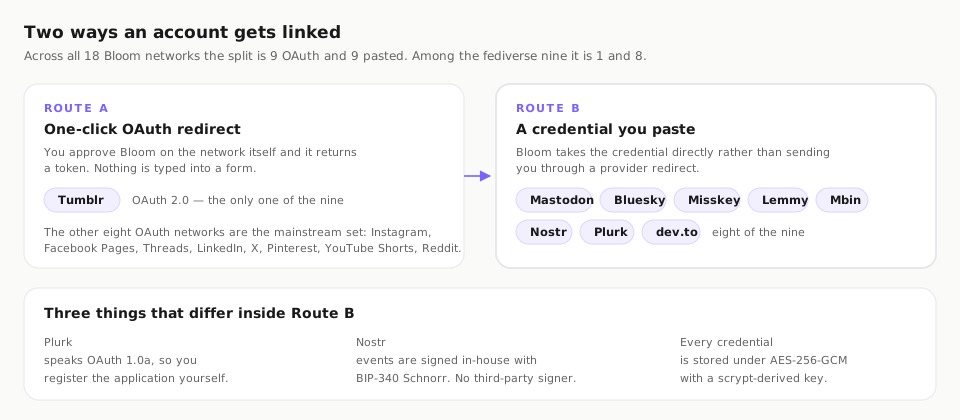
Mbin is one of the nine Bloom networks connected with a credential you paste rather than a one-click OAuth redirect — Tumblr is the only one of these nine that uses OAuth. Instances are independent, so each Mbin account is added on its own and gets its own budget and its own encrypted credential record.
Encrypted at rest
Credentials are stored under AES-256-GCM with a scrypt-derived key. How a credential arrived has no bearing on how it is kept.
Its own rate governor
maxPerDay and minIntervalMinutes are scoped to the connected account. Two Mbin accounts never share a budget, so a heavy week on one cannot throttle the other.
Roles and approvals still apply
Five workspace roles over eight actions, and a four-state approval chain before anything reaches the queue. A publish-only network is not an unreviewed one.
No engagement source, no inbox source.
Bloom reads engagement from ten of its eighteen networks and conversations from seven. Mbin is in neither set. Where the product has a written reason for a gap it states it — X read access is paid, Telegram’s Bot API exposes no view counts, Pinterest sits behind app review, Reddit needs its own OAuth application, Nostr needs relay subscriptions rather than a request. For Mbin the honest answer is narrower: Bloom registers no source, so it is listed as unread.
There is still a way to measure an Mbin post, and it does not depend on the platform’s API at all. Bloom’s short links use an eight-character code drawn from a 32-character ambiguity-free alphabet with per-platform UTM parameters, and click events are classified as bot, mobile or desktop before being tied through to conversions and leads. So a submission that reports no likes can still be the post that produced the pipeline — the Bloom overview shows how that attribution chain is built.
The same guarantees as the reporting networks.
Everything Bloom does to protect an account applies to Mbin unchanged. A network that reports nothing is not a second-class citizen in the queue — if anything the guards matter more, because a failure here will not show up later in an engagement chart that quietly went flat.
Failures are visible states
Sent, held, retrying, failed and skipped are all things you can see against the post. Five attempts with backoff doubling from 60 seconds, then it stops and says so.
Catch-up is capped
Ten posts per five-minute tick after downtime, and anything more than 24 hours past its slot is skipped rather than published late.
A stuck publish is reclaimed
After 15 minutes a reaper reclaims a hanging publish, which is the difference between a post that failed and a post that is simply missing.
Mbin among the eighteen.
Mbin belongs in a plan that also carries Lemmy and a microblog or two — Mastodon at 500 characters, say — composed once and tailored per network on a single weekly queue. The full eighteen-row table is on the coverage page, the queue constants on the publishing page, and the whole loop on the Bloom overview.
Mbin questions, answered plainly.
Can Bloom schedule posts to Mbin?
Does Bloom read Mbin engagement?
Do Mbin comments arrive in Bloom's inbox?
How does Mbin compare with Lemmy in Bloom?
Can I still attribute results from an Mbin post?
Publish to Mbin without the fiction.
Bloom runs on its own application and its own sign-in — an Autocloz account is not required. Connect an Mbin account and get real scheduled publishing, plus a written account of exactly what does not come back.