The one that connects in a click.
OAuth 2.0, long posts, and an honest read side.
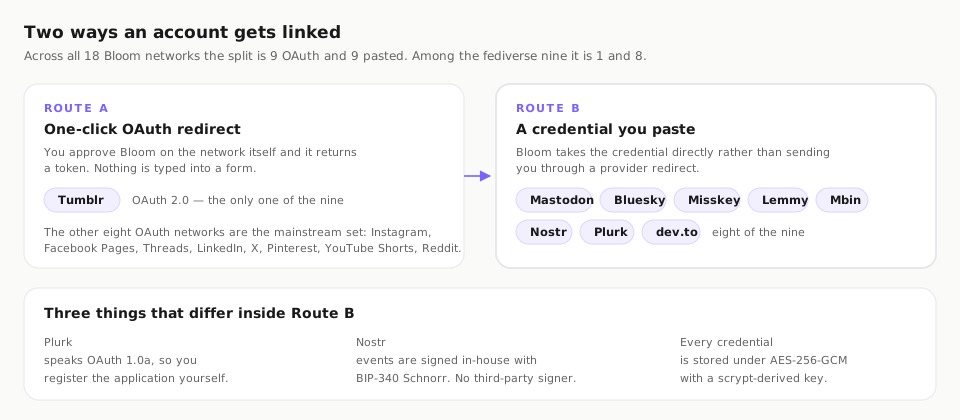
Tumblr is the odd one out of this group twice over. It is the only one of the nine that uses a modern one-click OAuth redirect, which makes it the easiest of them to connect — you approve Bloom on Tumblr and nothing is typed into a form. And it sits at the top of the character range at 5,000, which makes it a long-form surface rather than a microblog. What it does not do is report anything back, and Bloom is explicit about that rather than letting an easy connect flow imply a complete integration.
One of nine OAuth connections
Across all eighteen networks the split is nine one-click OAuth and nine pasted credential. Tumblr joins Instagram, Facebook Pages, Threads, LinkedIn, X, Pinterest, YouTube Shorts and Reddit on the OAuth side — the only member of the fediverse nine to do so, which is why its connect step feels like a mainstream network’s.
OAuth 2.0 against Plurk's 1.0a
The contrast worth noticing is with Plurk, which speaks OAuth 1.0a and links with a pasted credential instead of a redirect. Bloom keeps both working — two generations of the same protocol family — because the audiences on both networks did not leave when other tools dropped support.
Top of the range, shared with three others.
Tumblr accepts 5,000 characters in Bloom, level with Lemmy, Mbin and dev.to. That is ten times Mastodon and sixteen times Bluesky, which is the arithmetic behind the whole tailoring argument: the same idea cannot be one string when the networks it is going to differ by a factor of sixteen in what they will take.
Native threads exist on three of the eighteen networks and carousels on two; Tumblr is on neither list, and Bloom declares both absences at compose time instead of accepting a shape it cannot publish. The preflight runs the character count, the format rule and the media rule together and blocks anything that fails before it is stored — never truncating, because a post published with its ending removed is worse than a post that was refused. The complete table is on the coverage page.
Approve once on Tumblr, and you are done.
This is the shortest connect section in the family, which is the point. Tumblr uses OAuth 2.0: you approve Bloom on Tumblr, a token comes back, and nothing is pasted anywhere. Eight of the nine sibling networks require a credential instead, so if a low-friction first connection matters for the person setting the workspace up, Tumblr is the one to start with.
Stored like every other token
Connected-account credentials are held under AES-256-GCM with a scrypt-derived key. OAuth changes how the token arrives, not how it is kept.
Roles gate the connection
Five workspace roles — owner, admin, editor, client and viewer — are checked against eight distinct actions, and connecting an account is one of them. A one-click flow is still a permission, not a free-for-all.
Its own rate governor
maxPerDay and minIntervalMinutes are scoped to the connected account. Several Tumblr blogs under one brand are paced independently rather than sharing a single budget.
No engagement source, no inbox source.
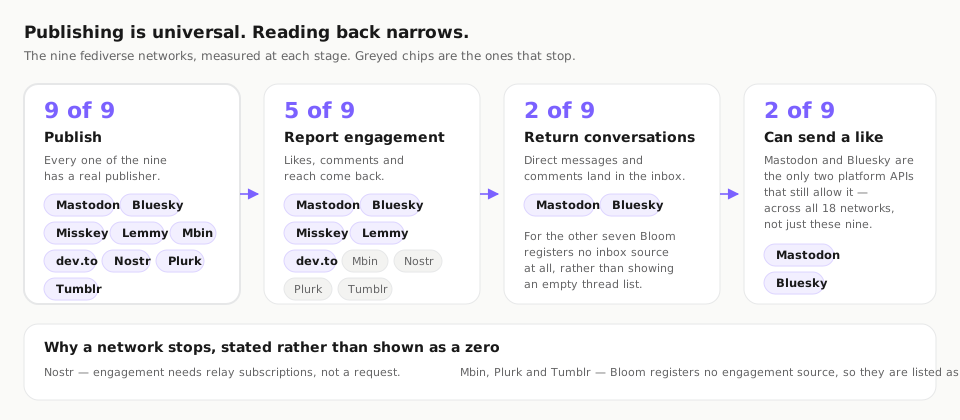
Bloom reads engagement from ten of its eighteen networks and conversations from seven, and Tumblr is in neither set. Where Bloom has a written reason for a gap it gives it — X read access is paid, Telegram exposes no view counts, Pinterest sits behind app review, Reddit needs its own OAuth application, Nostr needs relay subscriptions rather than a request. For Tumblr the accurate statement is narrower: Bloom registers no source, so it is listed as unread.
Measurement on a publish-only network runs through Bloom’s own attribution rather than the platform’s API. A short link carries an eight-character code from a 32-character ambiguity-free alphabet with per-platform UTM parameters, click events are classified as bot, mobile or desktop, and conversions and leads are tied back to the post that produced them. That chain is the same on all eighteen networks, which is what makes it the honest answer here — the Bloom overview shows how it is built.
The same protections as every other network.
Nothing about the connect method changes what happens after a post is approved. Tumblr sits on the same per-brand weekly queue, behind the same per-account governor, under the same bounded retry ladder as the seventeen networks beside it.
Slots belong to the brand
A slot is keyed by brand, platform, weekday, hour and minute, resolved in the brand’s own timezone and projectable up to 365 days ahead. Runway is flagged low under seven days and critical under three.
Recovery is gradual
Ten catch-up posts per five-minute tick after downtime, with anything more than 24 hours stale skipped rather than published late.
Autopilot inside the rules
A rolling 14-day horizon with a six-hour minimum between replans; everything it proposes still passes preflight, the approval chain and the governor.
Tumblr among the eighteen.
Tumblr is usually the long-form half of a plan whose short half goes to Bluesky or to Mastodon, with dev.to carrying anything technical. One idea, tailored per ceiling, on one weekly queue and one approval chain. The eighteen-row table is on the coverage page and the queue constants on the publishing page.
Tumblr questions, answered plainly.
Can Bloom schedule Tumblr posts?
How does Tumblr connect to Bloom?
Does Bloom read Tumblr engagement or messages?
What is Bloom's Tumblr character limit?
Can I measure a Tumblr post from Bloom?
Connect Tumblr in one click.
Bloom runs on its own application and its own sign-in — an Autocloz account is not required. Approve Bloom on Tumblr, write to the 5,000-character ceiling, and put it on the same weekly queue as the other seventeen networks.