Cross-post to dev.to without competing with yourself.
Long-form cross-posting, with the canonical handled.
Cross-posting technical writing has one well-known failure mode: you publish the same piece in two places and the copy you do not own starts outranking the copy you do. dev.to returns a canonical URL on publish, which is the mechanism that prevents exactly that — the cross-post can point at your own article as the original. Bloom keeps that URL rather than discarding it, so the relationship between your post and its dev.to copy is recorded instead of being something you have to remember.
A cross-post that credits the original
The canonical URL is what tells search engines which copy is the source. A cross-poster that ignores it is quietly building a competitor to your own article on somebody else’s domain. Because dev.to returns one and Bloom keeps it, the cross-post is an amplification rather than a duplicate.
Five thousand characters is a real article
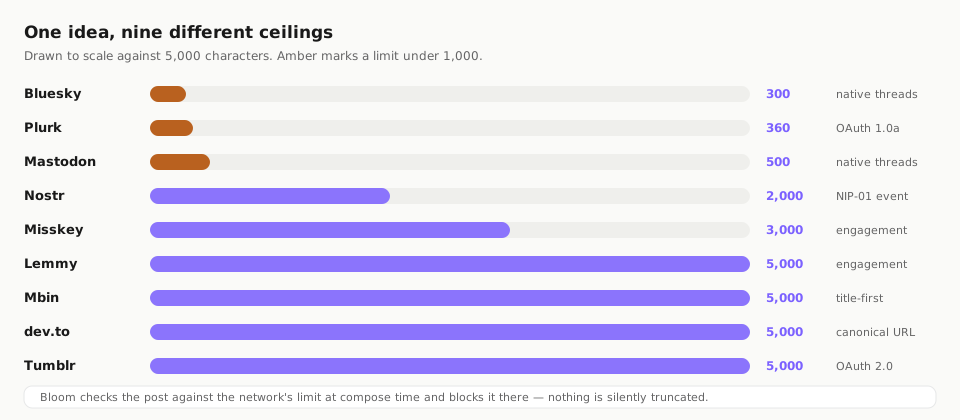
dev.to shares the top of Bloom’s limit range with Lemmy, Mbin and Tumblr. That is sixteen times Bluesky’s ceiling — a different kind of writing entirely, and the reason a developer-relations plan usually pairs one long piece here with several short ones elsewhere.
The long end of the range.
Five thousand characters is the top of what Bloom enforces, shared with three other networks. Against Bluesky’s 300 that is a factor of sixteen, and against Mastodon’s 500 a factor of ten. The practical consequence for a technical plan is that dev.to is where the argument lives and the microblogs are where it is pointed at — which is a content decision Bloom makes visible by enforcing each ceiling at compose time.
Native threads and carousels do not apply: threads exist on three of the eighteen networks and carousels on two, and dev.to is on neither list. Bloom declares that at compose time rather than accepting a shape that would fail at the slot. The same preflight runs the character count and the format rule together, which is why nothing is stored that cannot be published. Every limit across all eighteen networks is tabulated on the coverage page.
A pasted credential, then it runs.
dev.to is one of nine Bloom networks connected with a credential you paste rather than a one-click OAuth redirect. It is a single step when the account is added; after that, scheduled publishing and engagement collection both run against the stored credential without another prompt.
Encrypted at rest
Stored under AES-256-GCM with a scrypt-derived key, the same as every other connected account regardless of which of the two connect routes it used.
Approvals before a technical post ships
Four states — draft, internal review, client review and approved — and five roles across eight actions. A 5,000-character technical article is exactly the kind of post that benefits from a second reader before the queue touches it.
Its own pacing
The rate governor is per connected account, with maxPerDay and minIntervalMinutes set independently. Long-form cadence is usually slower than microblog cadence, and the governor is where that difference is expressed.
Engagement returns; conversations do not.
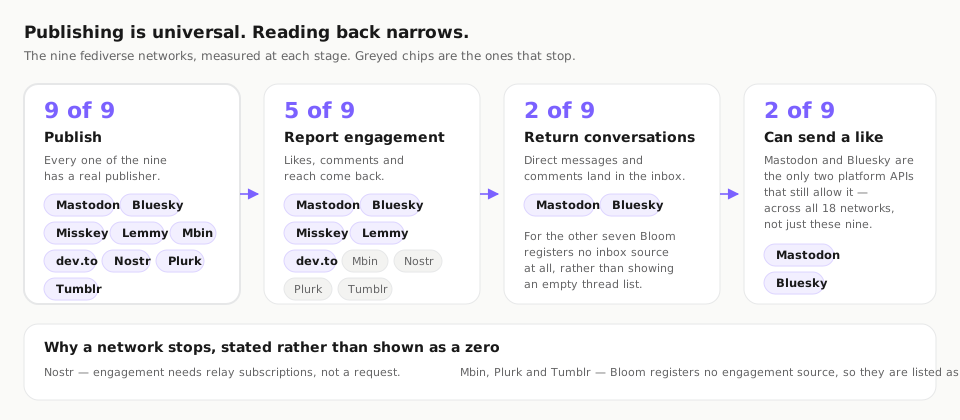
dev.to is one of ten Bloom networks that report engagement, which means a cross-post is not a hopeful gesture — reactions and reads come back as data next to the rest of the plan. It is not one of the seven that return conversations: Bloom registers no dev.to inbox source, so comments are read on dev.to itself. Saying that plainly costs nothing and is the difference between a claim and a checkable fact.
What dev.to reports is sampled at fixed ages after publishing and feeds the same twenty-four-arm learner as every other reporting network — twelve hooks, six formats and six time buckets tracked as twenty-four factored arms rather than four hundred and thirty-two combinations. Alongside that, a Bloom short link carries the click through to conversions and leads, which for a developer-relations team is usually the number that matters more than the reaction count. The seven networks whose conversations do arrive are listed on the inbox page.
Scheduling long-form work safely.
A long technical article represents real effort, and the failure that hurts is not a rate limit — it is the piece going out twice, going out a day late, or vanishing from the calendar without a state you can see. Bloom’s constants are aimed at those three.
A 30-day duplicate window
The same article will not be cross-posted twice to the same dev.to account inside 30 days, so re-running a plan does not produce a second copy competing with the first.
Late is treated as failed
Anything more than 24 hours past its slot is skipped rather than published late, and catch-up after downtime is capped at ten posts per five-minute tick.
Every outcome is visible
Sent, held, retrying, failed and skipped are states you can see against the post, after up to five attempts with backoff doubling from 60 seconds.
dev.to at the centre of a technical plan.
The usual shape is one long piece here and several short ones pointing at it — Mastodon at 500, Bluesky at 300, a title-first submission on Lemmy — composed once and tailored per network on one weekly queue. See the Bloom overview for how a post becomes an attributed lead, or the coverage matrix for the full table.
dev.to questions, answered plainly.
Can Bloom cross-post to dev.to on a schedule?
Does the dev.to cross-post compete with my own article?
Does Bloom read dev.to engagement?
Do dev.to comments arrive in Bloom's inbox?
How is a dev.to account connected to Bloom?
Cross-post to dev.to, canonically.
Bloom runs on its own application and its own sign-in — an Autocloz account is not required. Connect a dev.to account, schedule the long version, and read the engagement back beside every short post pointing at it.