Misskey, at three thousand characters.
A microblog with room to actually say it.
Misskey is the outlier of the microblogs. It has the shape of a timeline network — notes, reactions, a following feed — with a ceiling an order of magnitude above the ones people assume when they hear “microblog”. Three thousand characters is enough for a release note, a full explanation or a piece of writing that would otherwise have needed a link somewhere else. Bloom treats that as the interesting fact about the network and composes for it, instead of pushing a 280-character draft at a box that will take ten times more.
The same idea, not the same string
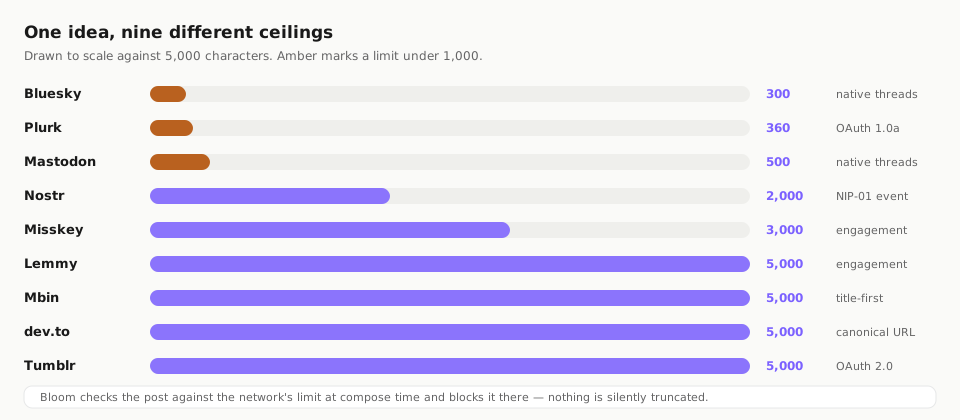
A draft that fills 3,000 characters on Misskey cannot be the same string sent to Bluesky at 300 — it is ten times too long. Bloom tailors one idea per network against each ceiling, which is the whole reason the limits are enforced at compose time rather than applied as a trim on the way out.
It reports, so it can be compared
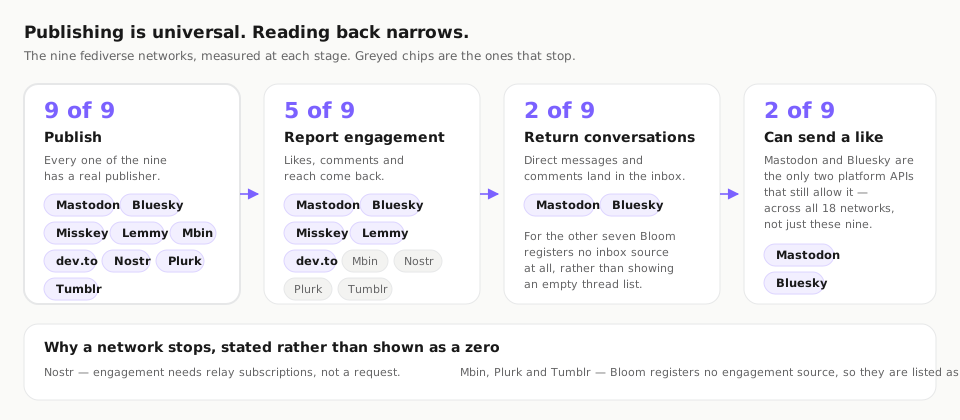
Misskey is one of five reporting networks among the fediverse nine, alongside Mastodon, Bluesky, Lemmy and dev.to. Ten of the eighteen report in total. The eight that do not are listed as not reporting rather than displayed as zeros, so an engagement comparison is never quietly wrong.
The second-highest ceiling of the nine.
Only the four 5,000-character networks accept more than Misskey. It takes half again what Nostr does, six times Mastodon and ten times Bluesky. That range — 300 at one end and 5,000 at the other, across networks a single plan routinely covers — is the concrete reason a cross-post tool that sends one identical string is broken by construction rather than merely lazy.
Native threads exist on three of the eighteen networks — Bluesky, Mastodon and Telegram — and Misskey is not one of them, which matters less here than it would elsewhere: with 3,000 characters available, a long idea fits in one note rather than needing a chain. Carousels are supported on two networks and Misskey is not one of those either. Bloom declares both at compose time. The complete table for all eighteen networks is on the coverage page, and how the queue handles a blocked post is on the publishing page.
Pasted credential, one per instance.
Misskey is one of nine Bloom networks linked with a credential you paste. Instances are independent, so each Misskey account is added separately and becomes its own connected account — with its own governor, its own place in the role model, and its own encrypted credential record.
Its own daily ceiling
maxPerDay and minIntervalMinutes are set per connected account, never per platform. Two Misskey accounts do not share a budget, and neither can burst past what that specific account should be doing.
AES-256-GCM at rest
Every connected-account credential is encrypted with AES-256-GCM under a scrypt-derived key, whichever of the two connect routes it came in by.
Approvals before anything publishes
Drafts move through four states — draft, internal review, client review and approved — before the queue will touch them, and five roles are checked against eight actions. A long Misskey note is exactly the kind of post worth reading twice before it goes out.
Engagement yes, inbox no, likes no.
Three separate questions, three separate answers, and Bloom gives all three rather than one reassuring sentence. Misskey reports engagement, so reach and reactions come back as data. It returns no conversations — Bloom registers no Misskey inbox source, so replies are read on Misskey. And Bloom can send a like on exactly two networks across the whole product, Mastodon and Bluesky, so not here.
Reported engagement is sampled at fixed ages after publishing and feeds the twenty-four-arm learner — twelve hooks, six formats and six time buckets tracked as twenty-four factored arms rather than four hundred and thirty-two combinations, which is what makes it informative in about a hundred posts. Anything the API does not return is still reachable through a Bloom short link, an eight-character code with per-platform UTM parameters carrying a Misskey note through to clicks, conversions and leads. The seven networks whose conversations do arrive are listed on the inbox page.
Long notes, on a queue that holds.
A 3,000-character note is a piece of work, and losing one to a scheduling failure is more annoying than losing a one-liner. The constants around the queue exist so a post that was written carefully is not published late, twice, or forty at a time.
Five attempts, then a visible state
A rejected publish retries up to five times with backoff doubling from 60 seconds under a six-hour ceiling — one, two, four and eight minutes in practice — then stops and reports rather than retrying forever.
Skipped rather than published late
Anything more than 24 hours past its slot is skipped, and catch-up after downtime is capped at ten posts per five-minute tick so a backlog drains instead of landing.
Autopilot inside your rules
Autopilot refills a rolling 14-day horizon with a six-hour minimum between replans, and everything it produces still passes preflight, the approval chain and the governor.
Misskey in a multi-network plan.
Misskey is rarely the only network in a plan, and its ceiling makes it the natural home for the long version of an idea whose short version goes to Bluesky and whose title-first version goes to Lemmy. All of it runs on one weekly queue and one approval chain. See the Bloom overview for the whole loop, or the coverage matrix for every row.
Misskey questions, answered plainly.
What is Bloom's Misskey character limit?
Does Bloom read Misskey engagement?
Do Misskey replies reach Bloom's inbox?
Can Bloom post a Misskey thread?
How is a Misskey account connected?
Give Misskey the long version.
Bloom runs on its own application and its own sign-in — an Autocloz account is not required. Connect a Misskey account, write to its real ceiling, and read the engagement back next to every other network you post to.