Plurk, on a protocol nobody else kept.
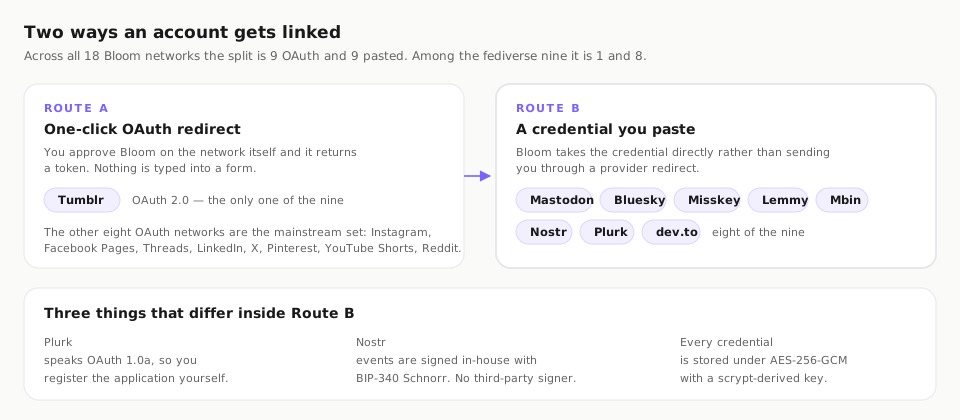
Old protocol, working integration.
Plurk is on this list for a reason that has nothing to do with the fediverse and everything to do with maintenance. OAuth 1.0a is signature-based rather than bearer-token-based, which is meaningfully more work to implement and is why most schedulers quietly dropped support for anything that still speaks it. The audience did not leave with the protocol. Bloom keeps the integration working, with the same queue, the same approvals and the same retry ladder as the seventeen newer networks around it.
Why 360 is its own problem
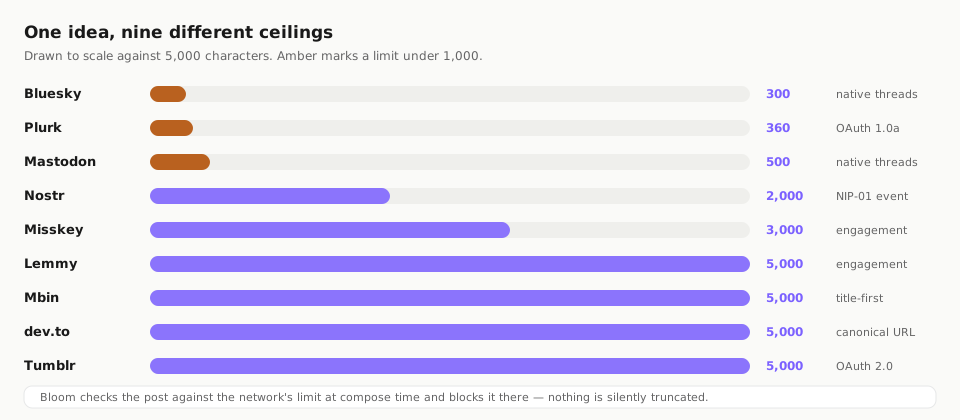
Plurk’s ceiling sits between Bluesky’s 300 and Mastodon’s 500, which is precisely the band where a draft written for one will silently fail on another. Bloom counts against each network’s own limit rather than the shortest in the plan, so a Mastodon post is not shortened to fit Plurk and a Plurk post is not cut to fit Bluesky.
No thread to fall back on
Native threads exist on three of the eighteen networks — Bluesky, Mastodon and Telegram — and Plurk is not one of them. At 360 characters with no chain available, the 360 is a hard editorial constraint rather than something a second post can absorb, and Bloom says so before the post is stored.
Second-tightest of the nine, with no thread.
Only Bluesky is tighter. Plurk takes 360 characters against Mastodon’s 500, Nostr’s 2,000 and the 5,000 that Lemmy, Mbin, dev.to and Tumblr accept. Combined with the absence of native threading, that makes Plurk the network in this family where the writing has to be finished before it is scheduled rather than trimmed afterwards.
Bloom’s preflight runs the character count, the format rule and the media rule together and blocks the post before it is stored if any of them fails. That is a deliberate choice against the alternative every naive cross-poster makes, which is to truncate and publish — leaving a public post with the verb missing and a log row that says it succeeded. Carousels are supported on two of the eighteen networks and Plurk is not one of them. All eighteen limits are listed on the coverage page.
The one network still on OAuth 1.0a.
Across Bloom’s eighteen networks the connect split is nine one-click OAuth and nine pasted credential, and Plurk sits in the pasted half. What makes it different from the other eight is the protocol behind it: Plurk speaks OAuth 1.0a, the only one of the fediverse nine that does, and a signature-based handshake does not fit the one-click redirect the OAuth 2.0 networks use.
A one-time step, then nothing
Linking the account happens once per workspace, not once per post. After the credential is stored, scheduling and publishing run against it with no further prompting — the extra work is entirely at the front.
Stored the same way as everything else
The credential is encrypted under AES-256-GCM with a scrypt-derived key, exactly like a token that arrived through a one-click redirect. An older protocol does not get weaker storage.
Its own throughput budget
The rate governor is per connected account — maxPerDay and minIntervalMinutes — so Plurk is paced independently of every other network and every other account in the workspace.
Publishing only, and Bloom says so.
Plurk is one of the eight Bloom networks that do not report engagement and one of the eleven that return no conversations. Where Bloom has a written reason for a gap it gives it — X read access is paid, Telegram’s Bot API exposes no view counts, Pinterest is behind app review, Reddit needs its own OAuth app, Nostr needs relay subscriptions. For Plurk the accurate statement is simply that Bloom registers no source, so it is listed as unread rather than shown as zero.
Attribution does not have to come from the platform. A Plurk post can carry a Bloom short link — an eight-character code from a 32-character ambiguity-free alphabet with per-platform UTM parameters — and the click events behind it are classified as bot, mobile or desktop before being tied to conversions and leads. That is the same chain that runs for every other network, and on a publish-only network it is the whole measurement story. The seven networks whose conversations do arrive in Bloom are listed on the inbox page.
An old API on a modern queue.
The integration is old-protocol; the scheduling around it is not. Plurk gets the same per-brand slots, the same per-account governor and the same bounded failure handling as the newest network Bloom supports, which is the part that decides whether a long-running schedule stays healthy.
Bounded retries
Five attempts per target with backoff doubling from 60 seconds under a six-hour ceiling — one, two, four and eight minutes in practice — then it stops and reports rather than hammering an API that already said no.
Gradual recovery
Ten catch-up posts per five-minute tick after downtime, with anything over 24 hours stale skipped instead of published late.
A year of slots, a 30-day guard
Weekly slots project up to 365 days ahead in the brand’s timezone, and the duplicate guard covers 30 days so the same post does not go out twice inside a month.
Plurk in a plan with seventeen others.
Plurk is almost always one row in a wider plan rather than a channel on its own. Bloom composes the idea once and tailors it per ceiling — 360 here, 2,000 on Nostr, 5,000 on Tumblr — on one weekly queue with one approval chain. The eighteen-row coverage table is on the networks page and the scheduling constants on the publishing page.
Plurk questions, answered plainly.
Can Bloom schedule Plurk posts?
Why does Plurk connect differently from the other networks?
What is Bloom's Plurk character limit?
Does Bloom read Plurk engagement or messages?
Can I measure a Plurk post at all?
Keep posting to Plurk.
Bloom runs on its own application and its own sign-in — an Autocloz account is not required. Register the app once, paste the credential, and Plurk joins the same weekly queue as the other seventeen networks.