A Mastodon scheduler that reads back.
Everything Bloom does on a Mastodon account.
Mastodon is the most complete of the nine networks no mainstream scheduler supports, because it is one of only two where all four capabilities line up at once: Bloom publishes to it, reads engagement back from it, receives its conversations into the inbox, and can send a like through it. That combination matters more than it sounds. A network you can only publish into is a broadcast; a network that answers is a channel you can actually run a brand on, and Mastodon is one of the two places in the fediverse where Bloom gives you the whole loop rather than half of it.
Threads are a real reply chain
Mastodon is one of only three Bloom networks with native thread support, alongside Bluesky and Telegram. A thread defaults to ten parts and can run to twenty-five, and it is published as an actual chain of replies rather than five separate posts numbered by hand. With a 500-character ceiling per part, twenty-five parts is a long argument — enough that the constraint stops being the reason you did not write it.
One of two networks Bloom can like from
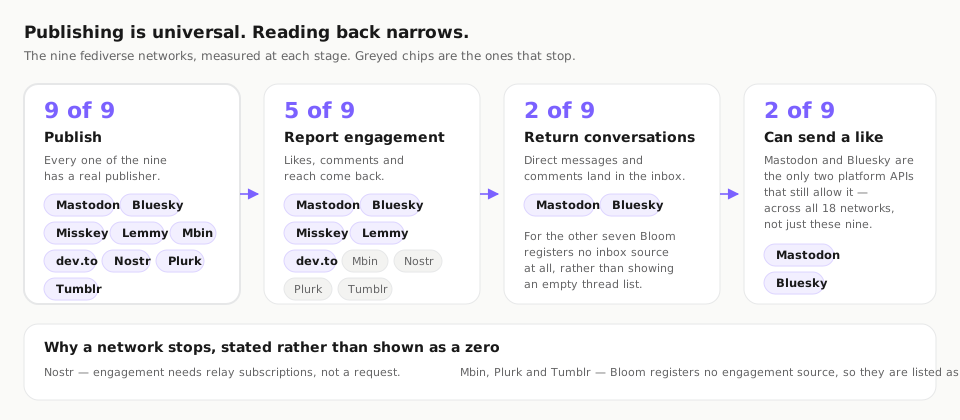
Across all eighteen networks, Bloom can send a like on exactly two: Mastodon and Bluesky. Every other platform has a written reason it cannot — Facebook removed the permission in 2018, Instagram and Threads expose no like endpoint, and LinkedIn’s reactions API is ambiguous enough that Bloom declines rather than fire a request that quietly does nothing. On Mastodon the endpoint is there, so the button is real.
The limit is checked before the post is stored.
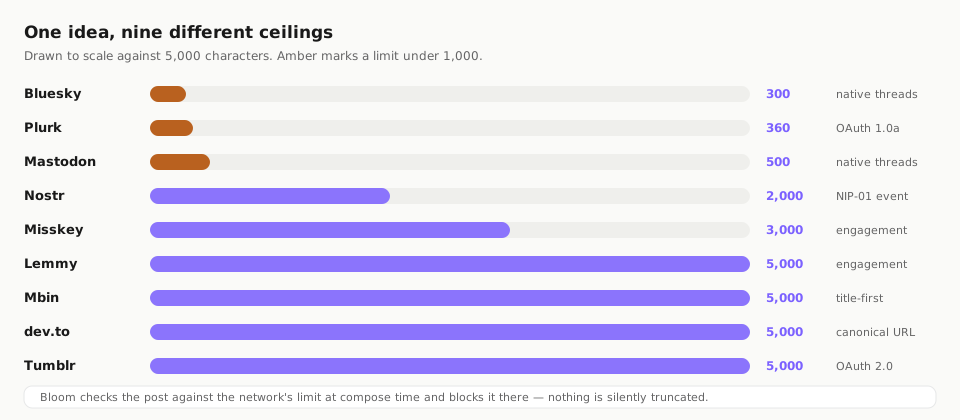
Five hundred characters is Mastodon’s default ceiling, and it is the number Bloom enforces. It sits in an awkward middle of the range: nearly twice what X accepts, two thirds more than Bluesky, and a tenth of what dev.to or Tumblr will take. That is exactly why posting one identical string to every network fails — the copy that reads well at 3,000 characters on Misskey is cut mid-sentence on Mastodon, and the copy written for Mastodon looks thin everywhere above it.
Bloom’s answer is not to truncate. An over-long Mastodon post is refused at compose time with the count shown against the limit, so you rewrite it while you are still looking at it rather than discovering a severed sentence on a public timeline an hour later. The same preflight declares which shapes the network accepts: a thread yes, a carousel no — carousels exist on only two of the eighteen networks, and Mastodon is not one of them. The full limit table for all eighteen lives on the coverage page, and how a blocked post is reported is part of publishing and scheduling.
Mastodon connects with a pasted credential.
Nine of Bloom’s eighteen networks link through a one-click OAuth redirect and nine take a credential you paste. Mastodon is in the second group, along with seven of the other eight fediverse networks — Tumblr is the only one of the nine that uses OAuth. Practically this means one extra step when you add an account and nothing at all afterwards: once the credential is stored, scheduling, publishing, engagement collection and the inbox all run against it without another prompt.
Stored encrypted, not in a column
Connected-account credentials are held under AES-256-GCM with a scrypt-derived key. That is the same treatment every Bloom connection gets, whether it arrived through an OAuth redirect or a paste — the connect method changes how a token reaches Bloom, not how it is kept once it is there.
Several Mastodon accounts, separately governed
The rate governor is scoped to a single connected account, not to the platform. Three Mastodon accounts under one brand therefore get three independent budgets — a maxPerDay ceiling and a minIntervalMinutes gap each — so a busy week on one never throttles the other two, and none of them can burst past what that account should be doing.
Who may connect it at all
Connecting an account is one of eight actions Bloom checks against five workspace roles — owner, admin, editor, client and viewer. An editor drafting Mastodon posts does not thereby hold the credential, which is the distinction that makes a shared agency workspace safe to hand to a client.
Engagement, conversations and likes all return.
Publishing is universal across Bloom’s eighteen networks; reading back is where coverage genuinely narrows, and Mastodon is on the generous side of every narrowing. It is one of ten networks that report engagement, one of seven that return conversations, and one of two that accept a like. Of the nine fediverse networks, only Mastodon and Bluesky clear all three — the table below is the honest version of that sentence, row by row.
Because Mastodon reports engagement, posts published there are sampled at fixed ages after publishing and feed the same twenty-four-arm learner as everything else — twelve hooks, six formats and six time buckets, tracked as twenty-four factored arms rather than four hundred and thirty-two combinations, so the model becomes informative in about a hundred posts instead of over years. Conversations arriving from Mastodon are keyed to the connected account that received them; Bloom does not claim a join back to the individual post that prompted a reply, because the inbox table holds no such reference.
The queue that keeps a Mastodon account safe.
Mastodon instances are run by people, often one person, and an automated client that floods a timeline is a moderation problem before it is a rate-limit problem. Bloom’s queue is built so that cannot happen by accident: slots belong to the brand, throughput belongs to the account, and recovery from an outage is deliberately gradual.
Ten catch-up posts per five-minute tick
After downtime Bloom releases at most ten backlogged posts per tick, so forty hours of queue never lands as forty posts in one minute. Anything more than 24 hours past its slot is skipped rather than published late.
Five attempts, then it stops and says so
If an instance rejects a post, Bloom retries up to five times with backoff doubling from 60 seconds under a six-hour ceiling — in practice one, two, four and eight minutes. Then it stops and reports the failure as a visible state.
The same content will not go out twice
A duplicate guard covers a 30-day window, so re-running a plan does not repost the same thing to the same Mastodon account inside a month. Slots project up to 365 days ahead and the runway warns below seven days.
Mastodon alongside the other seventeen.
Most teams do not want a Mastodon-only tool; they want Mastodon handled properly inside the schedule they already run. Bloom composes one idea, tailors it per network against each limit, and sends it — Mastodon at 500 characters, Bluesky at 300, Misskey at 3,000 — from the same box, on the same weekly queue, through the same four-state approval chain. Start with the Bloom overview for the whole loop, or the coverage matrix for the row-by-row table.
Mastodon questions, answered plainly.
Can Bloom schedule Mastodon threads?
What is Bloom's Mastodon character limit?
Does Bloom read Mastodon engagement and direct messages?
How do I connect a Mastodon account to Bloom?
Will Bloom flood my instance after downtime?
Schedule Mastodon properly.
Bloom runs on its own application and its own sign-in — an Autocloz account is not required. Connect one Mastodon account and watch the 500-character gate, the thread builder, the engagement figures and the inbox fill in against your own timeline.