Lemmy posts, measured rather than assumed.
Title-first posting, with a number attached.
A Lemmy post is not a status update. It is a submission to a community with a title doing most of the work, which is a different writing job from a microblog and a different scheduling job too — the title is the thing that gets read, and the body is what justifies the click. Bloom composes it that way rather than pushing a timeline post sideways into a link aggregator, and because Lemmy is one of the networks whose API reports back, what happened next is a measured figure instead of an impression formed by scrolling.
Image upload, stated because it is specific
Media upload is accepted by eight of Bloom’s eighteen networks, and Lemmy is one of them for images. That is worth naming because most link-aggregator integrations are text-and-URL only; an image submission behaves differently in a community feed, and the difference is visible in the engagement Bloom then reads back.
Reach you can compare across networks
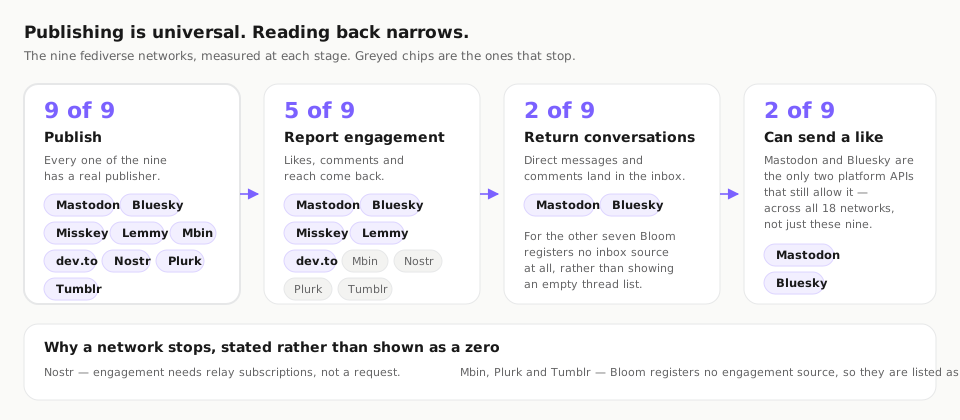
Because Lemmy reports, its posts sit in the same analytics as Mastodon, Bluesky, Misskey and dev.to — five of the nine fediverse networks. The four that do not report are listed as not reporting rather than shown as zeros next to them, which is what stops a comparison being quietly wrong.
Five thousand characters, and a title that matters more.
Lemmy sits at the top of Bloom’s limit range, level with Mbin, dev.to and Tumblr and sixteen times what Bluesky accepts. In practice the ceiling is rarely the binding constraint on a community submission — the title is. Bloom still enforces the 5,000 at compose time, because a body silently cut at the limit inside a community that values completeness is a worse outcome than being told to trim it yourself.
Native threads and carousels do not apply here: threads exist on three of the eighteen networks and carousels on two, and Lemmy is on neither list. Bloom declares both absences at compose time instead of accepting the shape and failing at the slot. The same preflight runs the character count, the media rule and the format rule together, which is why a Lemmy post either goes out as written or never gets stored. Every limit for all eighteen networks is tabulated on the coverage page.
A pasted credential, one per instance.
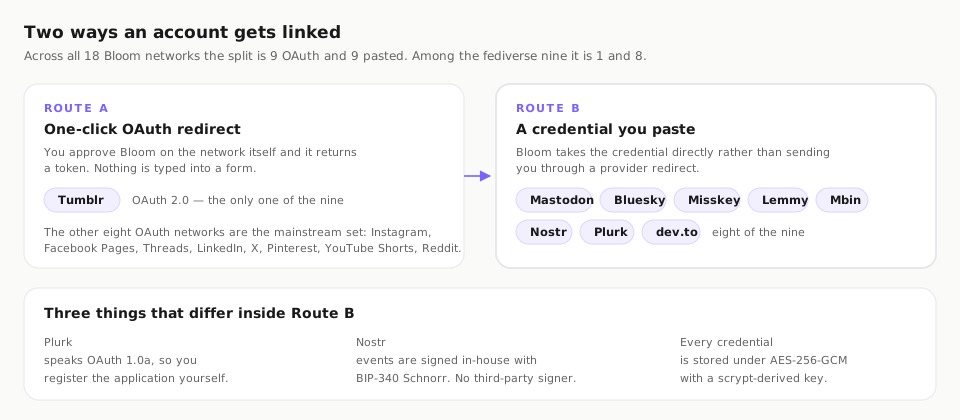
Lemmy is one of the nine Bloom networks connected with a credential you paste rather than an OAuth redirect. Since Lemmy instances are independent, an account is added per instance, and each one becomes its own connected account inside the workspace — with its own throughput budget and its own place in the role model.
Per-account throughput, not per-platform
The rate governor sits in front of each connected account with a maxPerDay ceiling and a minIntervalMinutes gap. Two Lemmy accounts on two instances therefore never share one budget, which matters because community norms differ sharply from one instance to the next.
Encrypted at rest
Credentials are stored under AES-256-GCM with a scrypt-derived key. The connect method decides how a credential arrives; it has no effect on how it is kept afterwards.
Five roles, eight actions
Owner, admin, editor, client and viewer are checked against eight distinct actions. Submitting to a community and connecting the account that submits are separate permissions, which is what lets a client watch a Lemmy plan without holding its credential.
Engagement returns. Conversations do not.
Lemmy is on the useful side of one line and the honest side of another. It is one of ten Bloom networks that report engagement, so likes, comments and reach come back as data. It is not one of the seven that return conversations: Bloom registers no Lemmy inbox source, so comment threads are read on Lemmy rather than in Bloom. Saying that plainly is worth more than a logo on a unified-inbox page, because the gap is discovered in week two either way.
What Lemmy reports feeds the same twenty-four-arm learner as every other reporting network — twelve hooks, six formats and six time buckets tracked as twenty-four factored arms, which is what makes it informative in roughly a hundred posts rather than over several years. For anything the API does not return, a Bloom short link still carries the click: an eight-character code from a 32-character ambiguity-free alphabet, with per-platform UTM parameters, tying a community submission through to conversions and leads. The seven networks that do return conversations are listed on the inbox page.
Community posting, paced deliberately.
Communities notice cadence faster than timelines do. A brand that submits four posts in a minute to one Lemmy community has done something socially visible, not merely technically excessive, so the pacing constants matter here for reasons that have nothing to do with API limits.
Ten catch-up posts per tick
After downtime Bloom drains a backlog at ten posts per five-minute tick and skips anything more than 24 hours stale. A community does not get yesterday’s queue all at once.
A 30-day duplicate window
The same submission will not be posted to the same Lemmy account twice inside 30 days — the guard that stops a re-run of a plan reading as a reposting habit.
Slots belong to the brand
A slot is keyed by brand, platform, weekday, hour and minute, resolved in the brand’s own timezone and projectable 365 days ahead. Runway is flagged low under seven days and critical under three.
Lemmy next to the rest of the plan.
Lemmy usually sits in a plan next to its closest sibling and a microblog or two. Bloom composes one idea and tailors it per network — a title-first submission here, the same shape on Mbin, a short post on Mastodon — on one weekly queue and one four-state approval chain. Read the whole loop on the Bloom overview or the eighteen-row table on the coverage page.
Lemmy questions, answered plainly.
Can Bloom schedule posts to Lemmy?
Does Bloom read Lemmy engagement?
Do Lemmy comments arrive in Bloom's inbox?
Can Bloom upload an image to Lemmy?
How is a Lemmy account connected?
Post to Lemmy, and know what happened.
Bloom runs on its own application and its own sign-in — an Autocloz account is not required. Connect a Lemmy account, schedule a title-first submission, and read the engagement back alongside every other network in the plan.